



Courtesy of our sister site Queen Anne View
By Laura
 The new Fire Station 20 won?t be your typical station ? it?ll be an example of green infrastructure and the City?s new model of sustainable design. The City challenged the Fire Station 20 design team to create a building that meets the criteria for LEED Platinum certification, and adheres to guidelines outlined in the Architecture 2030 Challenge. Key impacts include reducing water usage by 40% and energy usage by 30% ? with actual energy savings rising to 40-50% once the building is operational and running as planned.
The innovative green design elements include the following:
- Terraced gardens along the north and east will provide a protected green area for native plants and a vegetable garden for the firefighters
- Storm water runoff will be treated and filtered via systems as well as the garden?s vegetation
- Two green roofs will support infiltration and evapotranspiration, provide additional softscape reducing heat-island effect, and provide a habitat for birds and insects
- Ground source heat pumps will boost efficiency and reduce the operational costs of the heating and cooling system
- A rooftop solar panel array will provide all of the energy needed to heat the water used in the sinks and showers in the building, and store excess energy for use in the building.
- All plumbing fixtures will be ultra-low flow, with toilets using 1.28 gallons per flush, versus the standard 3.5 gallons
- Greywater from sinks, showers and laundry facilities will be collected, filtered, and reused on-site to flush toilets
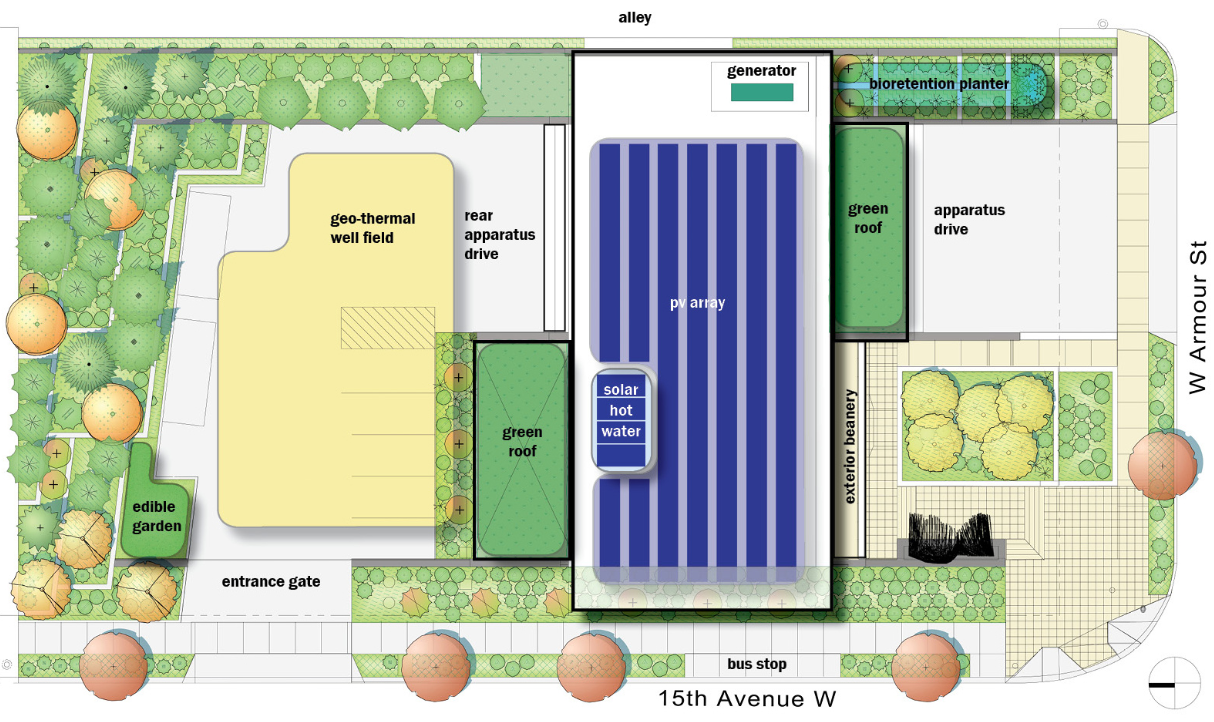
The City and Design team want to use the new green, sustainable station as an educational opportunity to engage and inform people about how the project protects the environment, operates efficiently, and does so all in the space of 9,446 square feet. The site will be accessible to the public on three sides and the grade will allow people to see the solar panels and green roofs from above. The City is currently exploring public signage highlighting the sustainable features of the station and a flip-dot electronic signboard connected to the station?s control system.
I’d like to know how much extra the “green” features cost, and would like to see an accounting of how much energy was actually saved.
A study will require a few years to complete, measuring ROI
Yeah, and I’m sure it’ll be objective and truthful.
Oh OK, good! To me, if it comes to pass,it would be just a study, to be judged on its own merits. Agreed?
I guess sarcasm doesn’t carry too well into comments, so I’ll have to be literal. I think this fire station will be one more of Seattle’s eco-fake boondoggles brought to us by a local government that has no respect for the taxpayers who finance the whole system.
Oh no I completely get your sarcasm. That part is easy. It’s just that an open mind is terrible thing to waste. Where do you think you really earned your prejudice?
By looking at how Seattle’s corrupt city government does its business.
Smug and cynical is so easy. Wish it worked for me, it would be less work. Thing is, if you’re that out of it, why dialogue at all? and why do anything? You will win over no one in a comments section environment – you come off as a know it all who’s beyond dialogue. So why stroke yourself? It’s just bitter…nothing
It doesn’t seem that you care much about the details, or at least that you don’t want anyone to look. So tell us, what’s your interest here? I’m just some of the suckers who pays for it. Yourself?
Yeah, me too. And I’m self-employed so I pay business license. It doesn’t matter. Your take on “the details” is negative and one-sided. You mock a lot of intelligent people behind the project, maybe without knowing it. Your taxpayer status ain’t that special pal, and your take is just…bitter-pretend-to-know-it all. Not impressed and certainly not intimidated. Heard it ALL before. I know your brand of politics. It’s all about disappointment and no one living up to your obviously ‘correct’ way of seeing things. You throw around the word ‘corrupt’ as if you’re the one to judge. You’re not, at least not in a comments section.
Do business with the city, either directly or indirectly?
Yes I have done business with the city and it has gone generally well. Of course you want to now qualify who can express an opinion here? Your experience, whatever it is, trumps mine? Arrogant. Venom? Really? Where? OK..play the victim for us..this’ll be fun
So you benefit from my tax dollars and then turn around and hurl insults. Not exactly surprising. Business as usual for the insiders and their hangers-on.